Getting a loan denial from your Canadian bank feels personal. It is not. Bank credit decisions are underwriting decisions, and underwriting decisions come out of a checklist that says a lot about the file and very little about whether your business is a good business.
Every year, thousands of Canadian owner-managed businesses get commercial loan declines from Schedule I banks. Most of those declines are recoverable. Some are recoverable at the same bank with a different package. Most are recoverable at a different lender who does what your file actually needs.
This piece walks through what a decline actually means, the four reasons banks say no ranked by how common each is, the three moves to make in the week after the decline, and when it is worth calling a capital advisor.
What a decline actually means
At a Schedule I bank, a commercial credit decision starts with a Relationship Manager gathering your file, moves to Credit Adjudication (also called Credit Risk), and ends with a documented approve or decline. The adjudicator is not the person you met with. They are looking at the paperwork.
When the file gets declined, one of four things has happened:
1. The paperwork did not answer the questions the adjudicator asked.
2. The paperwork answered them, but the bank's underwriting rules said no.
3. Your file was not a fit for this bank's program.
4. Something structural about the business (concentration, contingent liabilities, sector risk) triggered a hard-stop rule.
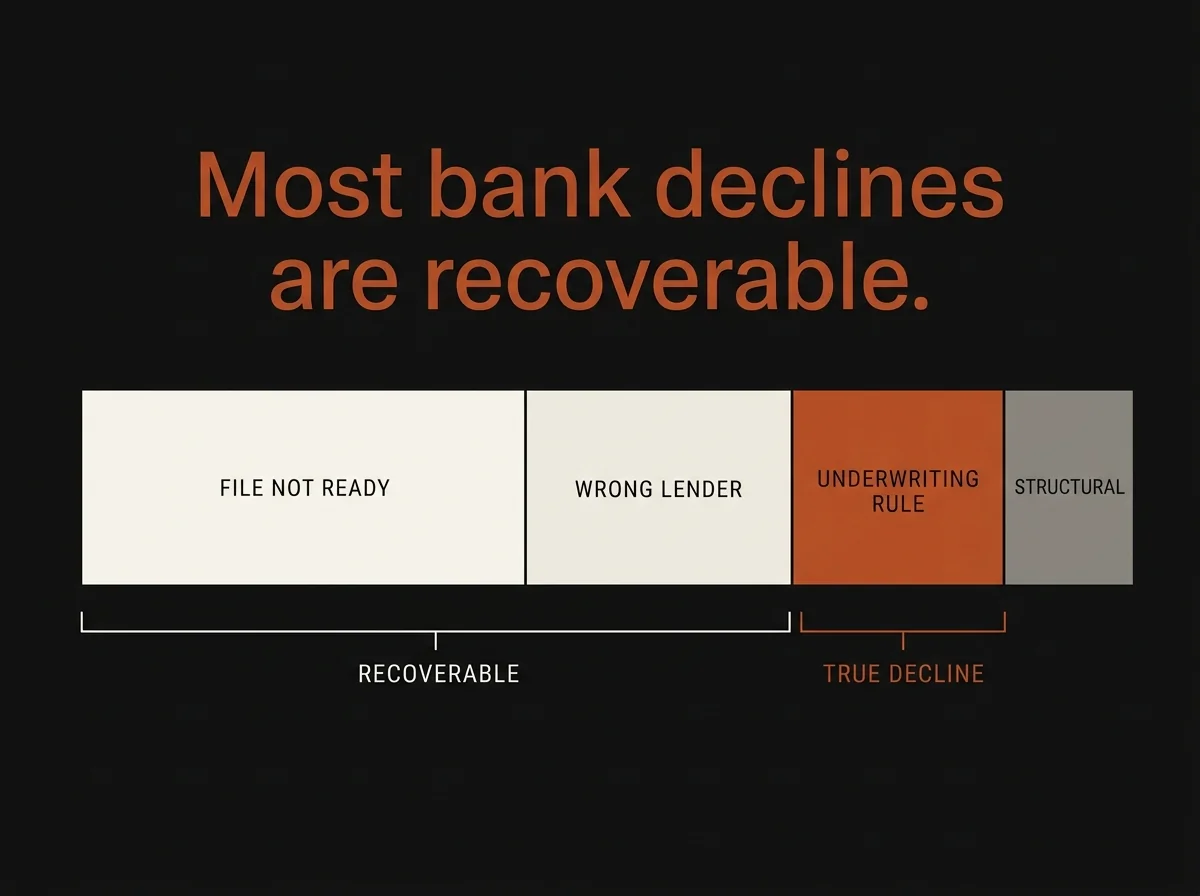
Only category 2 is a real "your business does not qualify" outcome. Categories 1, 3, and 4 are all recoverable, and they account for the majority of declines in the owner-managed market.
The four reasons banks decline commercial loans
1. The file was not ready
The most common reason. The credit package did not answer the questions the adjudicator was going to ask.
A well-prepared credit submission for a Canadian commercial loan needs:
- 01Two to three years of accountant-prepared financial statements (compilations or reviews, on an ASPE basis)
- 02Year-to-date interim financials
- 03Three-year forecast with income statement, balance sheet, and cash flow linked and reconciled
- 04Debt service coverage ratio (DSCR) calculated at 1.25x or better on normalized EBITDA
- 05Detailed use of funds (what the money is buying, line by line)
- 06Collateral schedule with recent valuations
- 07Personal net worth statements for principals
- 08Corporate structure diagram if there are related entities
- 09Aged receivables and payables summary
Miss any of these and the adjudicator has to either come back for more information (delays the decision, weakens the file) or make a decision on incomplete data (usually a decline).
How to tell if this was your reason. The Relationship Manager mentions "the file was not quite there yet" or "there were some things we could not get comfortable with." Translated: you did not give them enough to say yes.
2. The bank's underwriting rules said no
Every Schedule I bank has internal credit policy rules that are firm. Common ones that trip owner-managed businesses:
- 01DSCR below 1.25x on normalized earnings. This is the workhorse ratio. Most Canadian commercial lenders will not approve a facility where projected debt service coverage sits under 1.25x, even if every other line of the file is strong.
- 02Total funded debt above the bank's leverage cap for your industry. For most owner-managed businesses this sits between 2.5x and 4x EBITDA depending on sector. Restaurants and franchise systems typically cap lower; professional services can go higher.
- 03Concentration risk above the bank's threshold. If a single customer represents more than 30 to 40 percent of revenue, or a single supplier is critical to operations, most banks trigger additional review or decline.
- 04Insufficient collateral coverage. For asset-secured facilities, banks want loan-to-value in the 65 to 80 percent range depending on asset class. Commercial real estate can go higher; receivables and inventory lower.
- 05Insufficient owner equity in the deal. For acquisitions and major capital projects, banks typically want owners to fund 20 to 30 percent of the purchase price or project cost in equity. Less than that and the file struggles.
How to tell if this was your reason. The letter or conversation cites a specific ratio or specific policy. If you hear "we could not get comfortable with the coverage" or "our leverage capacity for this type of business is..." you are in this category.
3. Wrong lender for your file
This is the most-often-missed category. The file was fine. The bank was wrong for it.
Schedule I banks each have appetite in specific sectors, deal sizes, and structures. Some banks lean into professional services and technology. Some lean into commercial real estate and asset-backed lending. Some avoid restaurants and hospitality entirely; others compete aggressively there.
Beyond the Schedule I banks, the Canadian commercial lending market is broader than most owners realize:
- 01BDC (Business Development Bank of Canada) does deals a chartered bank will not touch: growth-stage businesses, expansion capital, longer amortizations, subordinated debt.
- 02EDC (Export Development Canada) takes files with an export component that chartered banks decline.
- 03CSBFL (Canada Small Business Financing Program) underwrites government-guaranteed loans up to $1.15 million for equipment, leasehold improvements, real property, and more recently working capital and intangible assets. Participating lenders can approve CSBFL applications that would fail as conventional commercial loans.
- 04Farm Credit Canada does agriculture files no chartered bank will touch.
- 05Credit unions have local commercial lending programs, often more flexible on structure than Schedule I banks.
- 06Equipment finance companies do deals banks decline because the asset alone, not the borrower, supports the transaction.
- 07Private credit funds do non-standard structures, faster timelines, higher rates.
How to tell if this was your reason. The decline reasoning does not cite a specific coverage or leverage problem. You hear "this file just is not what we do" or "we are not the right partner for this deal."
4. Structural or sector-specific hard stop
Least common but hardest to work around. Something about the business triggers a bank policy that says no automatically:
- 01Cannabis, adult entertainment, firearms, cryptocurrency, and a few other sectors are on many banks' exclusion lists.
- 02Businesses with active CRA collection actions or unresolved WSIB or provincial workers' comp arrears cannot be underwritten until the arrears are cleared.
- 03Personal credit issues on the guarantors (recent bankruptcies, active consumer proposals) will stop the file at Schedule I banks.
- 04Contingent liabilities from prior transactions (unresolved earn-outs, personal guarantees on other files) count against total debt capacity.
How to tell if this was your reason. The decline is unambiguous. There is a specific issue named and the bank is clear it will not proceed.
What percentage of declines fall into each category
In the owner-managed and mid-market space, based on the pattern we see:
- 01Category 1 (file not ready): roughly 40 to 50 percent of declines
- 02Category 2 (real underwriting concern): 20 to 25 percent
- 03Category 3 (wrong lender for the file): 20 to 30 percent
- 04Category 4 (structural hard stop): 5 to 10 percent
The strategic implication: 60 to 80 percent of Canadian commercial loan declines are recoverable at the same or a different lender with the right package. That is a very different number than most owners assume after their first decline.
The three moves after a decline
Move 1: Get the actual reason
Most declines come with a vague explanation. That is not accidental. Bank credit staff are trained to be non-specific about the exact policy rule that killed a file, partly for legal reasons and partly because giving specifics feels like negotiating.
You are entitled to more clarity than you get by default. Ask specifically:
- 01Was this a coverage issue? What DSCR did you calculate?
- 02Was this a leverage issue? What EBITDA multiple triggered the decline?
- 03Was this a program mismatch? Which of your credit programs was the file evaluated against?
- 04Was there a specific policy exception the file could not clear?
The Relationship Manager may not answer all four fully, but the pattern of what they will and will not say tells you which of the four categories above applies. If you cannot get a specific answer, ask for the credit summary that went to adjudication. Not every bank will share it, but the request itself sometimes surfaces more detail.
Move 2: Do not re-apply to the same bank without a materially different file
The biggest wasted move after a decline is going back to the same bank three weeks later with the same file and hoping for a different adjudicator. Bank credit systems flag re-applications. A re-application without material change to the file, the business, or the request comes back declined faster than the first application, and now you have two declines on the record instead of one.
If you want to try the same bank again, the file has to be materially different:
- 01New financials showing improved coverage
- 02Different structure (shorter amortization, additional owner equity, more collateral)
- 03Different program (CSBFL instead of conventional term debt)
- 04Different use of funds
Otherwise, the correct move is a different lender.
Move 3: Match the file to the right lender
If Move 1 revealed a program mismatch (category 3 above), the recovery move is straightforward: identify the lenders whose credit programs match your file and re-approach.
Some common patterns:
- 01A restaurant leasehold improvements file rejected as conventional debt often approves as CSBFL through a participating credit union.
- 02A growth-stage technology company with weak historical coverage but strong forward projections often finds BDC before it finds a chartered bank.
- 03A real estate holding company declined on cash flow coverage often approves through an alternative commercial lender that underwrites primarily on loan-to-value rather than DSCR.
- 04An agricultural operation declined by a chartered bank almost always finds Farm Credit Canada.
- 05An acquisition of an operating business often needs a stack: senior debt from a bank, CSBFL for eligible components, vendor take-back for the gap, plus owner equity. No single lender does all of it.
The work here is knowing the Canadian lender landscape well enough to pick the right one on the first re-approach and to structure the request so it matches their appetite.
When to call a capital advisor
Most declines are recoverable without professional help. A file that was not ready can be prepared properly. A file that hit the wrong lender can be re-approached at the right one.
The declines that warrant calling a borrower-side advisor:
- 01Multiple declines already on the record. Each additional decline weakens the file for the next lender. Getting the file right before the next submission matters more each time.
- 02Time pressure. If the financing needs to close inside a specific window (acquisition closing date, seasonal working capital ramp, vendor deadline) and you are already partway through a compressed timeline, professional help compresses the remaining steps.
- 03Facility size above what your accountant or bookkeeper can package. Roughly speaking, commercial credit submissions above $1 million benefit from a capital advisor who builds packages that credit committees actually approve. Above $5 million, it is close to essential.
- 04The financing structure is non-standard. Acquisition financing, multi-lender stacks, partner buy-outs, and cross-border facilities all involve structure work that a general accountant is not built to handle.
- 05You are already at the top of your bank's leverage capacity. Adding another facility from the same bank is not going to work. A capital advisor knows which alternative lenders take files that hit conventional leverage caps.
A borrower-side capital advisor prepares the credit package, matches the file to lenders whose programs fit, runs a competitive process where the file supports it, and negotiates term sheets line by line. Independent means the advisor is not paid by the lender, so their recommendation on which offer to accept is not compromised by placement fees.
What Sapere Advisory does with a declined file
Sapere Advisory's flagship service is [Capital Advisory](/advisory/capital-advisory): arranging and negotiating business financing across the full Canadian lender landscape. Our clients are typically owner-managed and mid-market businesses with $2M-$100M in revenue and financing needs from $250K to $25M.
When a client comes to us after a decline, the engagement usually looks like this:
1. Capital diagnostic. Within days of engagement, a clear read on how much capital the business can carry, what kind of structure fits, which lenders are the right shortlist, and roughly what terms to expect. Delivered before any lender is approached.
2. Financial model rebuild. A three-year, three-statement forecast to Canadian underwriting standards, tested at the 1.25x DSCR threshold most lenders apply, with documented assumptions and downside scenarios.
3. Credit package rebuild. A submission-ready package in the format credit committees actually approve, not the format a bookkeeper produces.
4. Lender selection and outreach. Shortlisted lenders whose programs match the file, approached on your behalf, with competitive pressure where the file supports it.
5. Term sheet negotiation. Offers compared on a like-for-like basis. Pricing, fees, security, guarantees, covenants, reporting, and prepayment terms negotiated line by line.
The decline itself is often the smallest part of the story. What matters is what happens in the six to ten weeks after it.
Getting started
If your bank recently declined a facility and you want a candid read on why the file was declined and what would move it forward, the initial conversation is straightforward. Book a capital diagnostic through the [Capital Advisory](/advisory/capital-advisory) page, or start with an [Advisory overview](/advisory) if you want to see the full service list before scoping anything.